
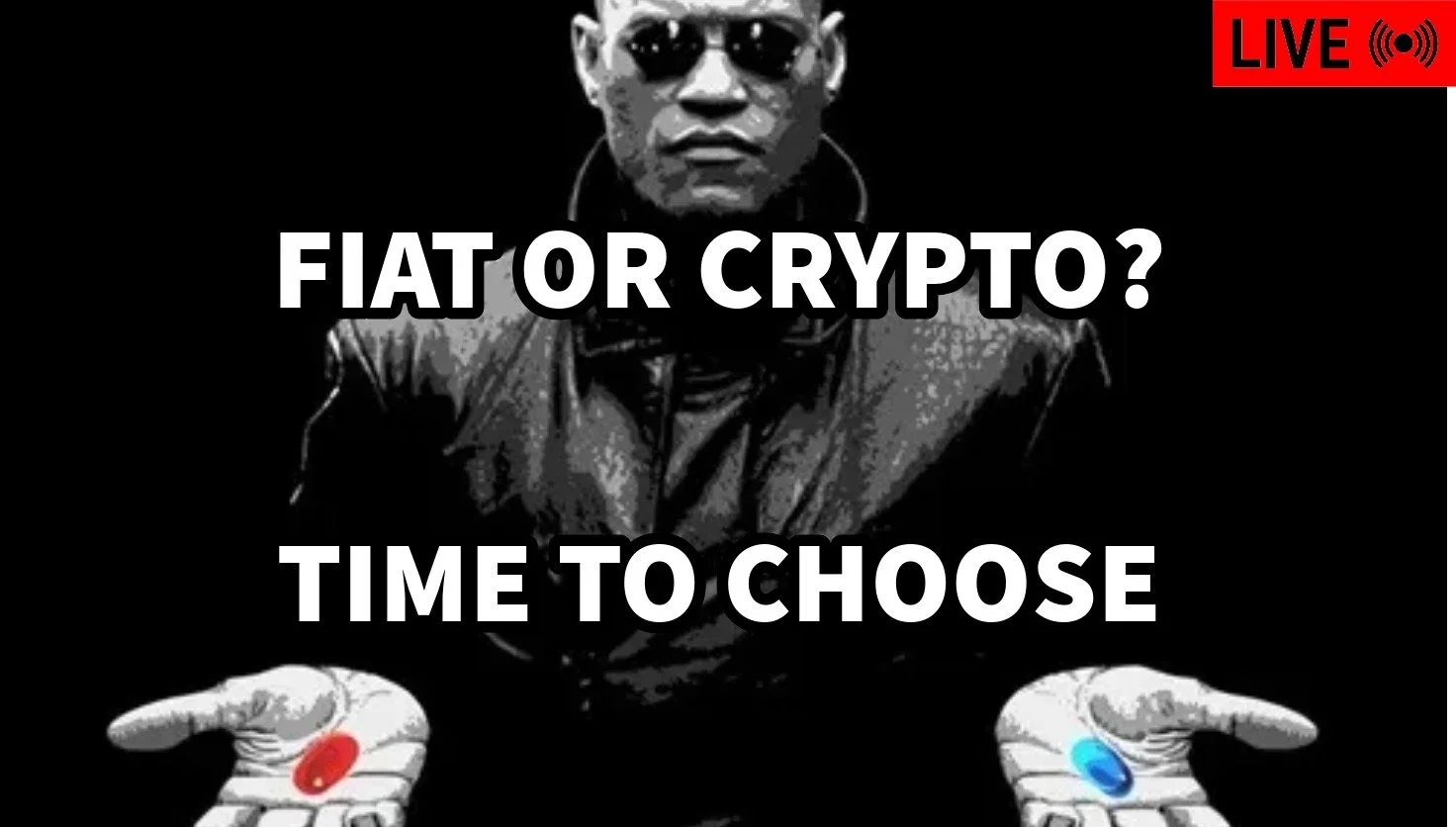
FIAT OR CRYPTO? TIME TO CHOOSE
There comes a point when you have to stop sitting on the fence.
For years, people have laughed at Bitcoin.
They laughed at crypto.
They called it fake money.
They called it a scam.
They said it would disappear.
And yet here we are.
Bitcoin is still here.
Ethereum is still here.
Crypto is still growing.
The technology is still evolving.
And meanwhile, the money sitting in your bank account continues operating inside the exact same system we've been told not to question.
So maybe it's time we ask the uncomfortable question:
FIAT OR CRYPTO?
Because eventually, you're going to have to decide what kind of financial system you believe in.
WHAT EXACTLY ARE YOU HOLDING?
Most people wake up every morning, go to work, earn dollars, deposit those dollars into a bank and never really ask what those dollars are.
We just accept them.
Why?
Because everyone else does.
That's fiat currency.
It has value because governments declare it money and because society agrees to use it.
And listen — I'm not telling you tomorrow morning you should throw every dollar you own into Bitcoin.
That's ridiculous.
We still live in a world where you need dollars.
Your mortgage is in dollars.
Your groceries are priced in dollars.
Your electric bill doesn't care how bullish you are on Ethereum.
But there is a much bigger conversation happening.
Where do you want to store the value of your work?
That's the question.
YOUR MONEY REPRESENTS YOUR TIME
This is the part people don't talk about enough.
Money isn't just numbers.
Money represents your time.
You worked for it.
You gave somebody hours of your life in exchange for it.
Maybe you worked 40 hours.
Maybe 60.
Maybe you built a business.
Maybe you sacrificed weekends.
Maybe you missed time with your family.
And in exchange for that time, you received money.
So when the purchasing power of that money declines, something else is happening too.
The value of the time you already spent earning it is being diluted.
Once I understood that, I couldn't look at money the same way again.
BITCOIN CHANGED THE QUESTION
Bitcoin introduced something radically different.
There will never be more than 21 million Bitcoin.
Nobody can wake up tomorrow and decide there should suddenly be 25 million.
There isn't a central bank controlling the supply.
There isn't a CEO of Bitcoin.
There isn't a company headquarters you can shut down and make the network disappear.
It gave us something the internet had never truly had before:
Digitally scarce money.
And that changed everything.
The question stopped being:
"Why would anybody buy Bitcoin?"
The better question became:
"Why would I not want exposure to an asset with mathematically limited supply?"
That's a completely different conversation.
CRYPTO IS BIGGER THAN BITCOIN
And then Ethereum came along.
Now we weren't simply talking about digital money.
We were talking about programmable money.
Smart contracts.
Stablecoins.
Tokenized assets.
Decentralized finance.
Digital ownership.
Global payments.
Applications that can move value without relying on the traditional financial infrastructure we've used for generations.
And yes, crypto has problems.
There are scams.
There are bad actors.
There are ridiculous meme coins.
There are projects that will probably disappear completely.
There are exchanges that fail.
There are people who take insane amounts of leverage and get destroyed.
But don't confuse the failures built on top of crypto with the technology itself.
The internet had scams.
The internet had terrible companies.
The dot-com bubble destroyed billions of dollars.
That didn't make the internet useless.
It meant people had to figure out what actually had value.
Crypto is going through the same type of battle.
YOU DON'T HAVE TO CHOOSE 100% OR 0%
When I say:
FIAT OR CRYPTO? TIME TO CHOOSE.
I'm not saying you need to walk into the bank, withdraw every dollar and put your entire life savings into some random altcoin.
That's not the point.
The real choice is intellectual.
Do you believe the financial system of the future will look exactly like the financial system of the past?
That's the decision.
Because I don't.
I believe money is becoming digital.
I believe ownership is becoming digital.
I believe markets are becoming increasingly global.
I believe people want faster access to their assets.
I believe people want greater control over their money.
And I believe crypto is going to be part of that future.
How big a part?
That's what the market is still figuring out.
THE OLD WORLD AND THE NEW WORLD ARE COLLIDING
What's fascinating is that the line between traditional finance and crypto is already beginning to blur.
People used to talk about them like two completely separate universes.
Wall Street over here.
Crypto over there.
But increasingly, those worlds are colliding.
And that's exactly what I expected.
The future probably isn't going to be some cartoon where every bank disappears and everybody pays for coffee with a volatile altcoin.
It's going to be much more interesting than that.
Traditional finance will adopt pieces of crypto technology.
Crypto will adopt pieces of traditional finance.
Bitcoin will continue doing its own thing.
Stablecoins will continue making digital dollars easier to move.
Tokenization will continue expanding.
And somewhere in the middle, a completely new financial system will emerge.
THE BIGGEST RISK MAY BE IGNORING IT
Everyone talks about the risk of owning cryptocurrency.
And they're right.
Crypto is risky.
Bitcoin can drop dramatically.
Ethereum can drop dramatically.
Altcoins can fall 80%, 90% or disappear entirely.
You need to understand that before putting one dollar into this market.
But there's another type of risk.
The risk of refusing to learn.
Imagine seeing the internet in the 1990s and saying:
"I don't understand this, so it must be useless."
Imagine seeing smartphones and saying:
"My flip phone works fine."
Imagine seeing streaming and saying:
"People will always rent DVDs."
Technological change doesn't ask permission.
It just happens.
And by the time everyone agrees something has changed, much of the change has already occurred.
That's why education matters.
THIS ISN'T ABOUT GETTING RICH TOMORROW
If your entire crypto strategy is:
"What coin can make me rich next week?"
You're probably missing the bigger picture.
The real revolution is bigger than price.
It's about ownership.
It's about scarcity.
It's about permissionless networks.
It's about being able to move value globally.
It's about separating certain types of financial activity from institutions that traditionally acted as mandatory middlemen.
And yes — there will be fortunes made.
There will also be fortunes lost.
That's what happens when disruptive technology meets speculation.
Your job is to understand the difference.
TIME TO CHOOSE
So when I say FIAT OR CRYPTO?, I'm really asking something deeper.
Are you going to blindly accept the financial system handed to you?
Or are you going to educate yourself about the system being built right in front of you?
You don't have to hate the dollar.
You don't have to worship Bitcoin.
You don't have to become some crypto extremist.
But you should understand what is happening.
Because we are watching two financial worlds collide.
One is built around institutions, governments and monetary policy.
The other is built around code, networks, digital scarcity and global participation.
And I believe we're going to look back on this period and realize just how important it was.
The question is:
Were you paying attention?
Fiat or crypto?
Old system or new system?
Centralized or decentralized?
Maybe the future ultimately includes pieces of both.
But one thing is becoming harder to ignore:
Crypto isn't asking for permission to become part of the financial system.
It's already here.
And now?
IT'S TIME TO CHOOSE.
This article is for educational and entertainment purposes only and is not financial advice. Cryptocurrency involves significant risk. Always research assets carefully, understand the risks involved and never invest money you cannot afford to lose.